No-Code + AI: Why This Combination Is Growing So Fast
Yurii Kulakovskyi · Team ·
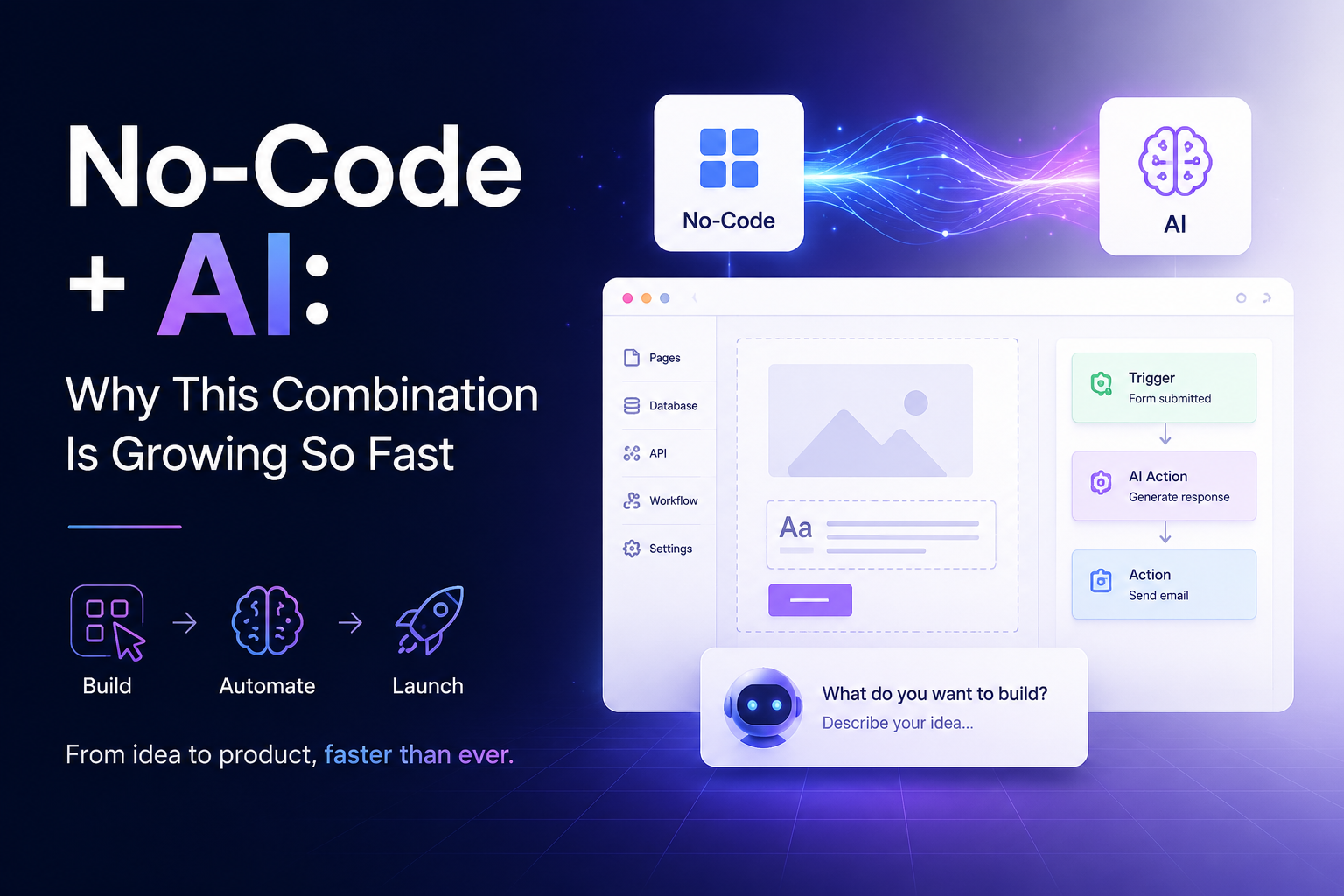
No-Code + AI: Why This Combination Is Growing So Fast
No-code combined with AI is fundamentally changing how software is built, allowing founders and creators to turn ideas into working products faster than ever before.
I Used to Write Everything from Scratch
As a developer, I spent years doing things the "right" way. Database schemas, REST APIs, authentication flows, deployment pipelines — I built all of it by hand, line by line. It was satisfying in a craftsmanlike sense. It was also slow, expensive, and often overkill for what the product actually needed.
Then I started experimenting with no-code tools. Not because I couldn't write the code, but because I realized I was spending 80% of my time on infrastructure that had nothing to do with the actual problem I was solving.
Adding AI to the mix changed everything again.
Why This Combination Is Different
No-code on its own removes the technical barrier to building software. AI removes the knowledge barrier. Together, they collapse the gap between having an idea and having a working product to a degree that would have seemed impossible five years ago.
Here's what I mean in practice:
- No-code handles the scaffolding — databases, user authentication, workflows, UI components, integrations — without writing a single line.
- AI handles the logic, content generation, data transformation, and decision-making that used to require custom backend work or a data science team.
What once took a backend engineer three weeks can now be prototyped in a weekend. That's not hype — I've lived it.
My Turning Point
The shift happened when I was building a side project — a tool to help small teams manage client feedback. My instinct was to spin up a Node.js server, wire up a database, and build the whole thing from scratch.
Instead, I tried building it with a no-code platform for the structure and hooked in an AI layer to automatically categorize and summarize incoming feedback. The entire prototype was live in two days. Two days that previously would have been two months.
More importantly, I could iterate in hours rather than weeks. When users wanted changes, I wasn't untangling deeply coupled code — I was adjusting visual workflows and tweaking prompts.
Why Now Is the Right Time
A few forces are converging simultaneously:
1. AI capabilities crossed a threshold. Large language models are now reliable enough to be trusted in production workflows. Summarization, classification, generation, extraction — these aren't research demos anymore. They're features.
2. No-code platforms matured. Tools like Bubble, Webflow, Retool, and Glide grew up. They handle real user loads, support proper data modeling, and integrate with virtually every API on the market.
3. The cost of experimentation collapsed. Spinning up an AI-powered tool no longer requires a machine learning team or a cloud infrastructure budget. A solo founder with a laptop can build something genuinely useful on a free tier.
4. The barrier to distribution dropped too. Building the product is only half the challenge. With no-code landing pages, no-code email automation, and AI-assisted content, a single person can build and distribute a product without a full team.
What Developers Are Missing If They Ignore This
I was skeptical for a long time. No-code felt like a toy. Something for non-technical people who didn't know better.
That was wrong.
No-code isn't the absence of engineering thinking — it's a different level of abstraction. The same way I don't write assembly to build a web app, I don't need to write a custom auth system to build a useful product. The craft shifts from implementation to architecture, product judgment, and knowing which abstractions to trust.
AI amplifies this further. The developer advantage in a no-code + AI world isn't writing code — it's knowing what to build, understanding data flows, and having the instincts to spot when an AI output is wrong or when a workflow will break under edge cases. That expertise is still enormously valuable. It's just applied differently.
The Tools Worth Knowing
If you're starting out, here's where to focus:
| Category | Tools to Explore | |---|---| | App building | Bubble, Glide, Softr | | Automation & workflows | Make (Integromat), n8n, Zapier | | AI integration | Claude API, OpenAI, Relevance AI | | Internal tools | Retool, AppSmith | | Frontend / sites | Webflow, Framer | | Databases | Airtable, Notion, Supabase |
You don't need all of them. Pick one app builder, one automation tool, and one AI integration layer — that's enough to build something real.
The Bigger Picture
The no-code + AI combination isn't just a productivity tool for developers. It's a structural shift in who gets to build software and how fast ideas can be validated.
The old model: idea → funding → team → build → launch.
The new model: idea → build → launch → learn → iterate.
The feedback loop has compressed from years to weeks. For anyone with a problem worth solving, that's a genuine unlock.
I'm a developer. I still write code when it matters. But the bar for when it matters has moved, and I've moved with it. If you haven't started experimenting with this combination yet, there's no better time than now.
Have thoughts or questions? I'd love to hear what you're building.