Common Mistakes Companies Make When Implementing AI
Oleh Kobrynovych · Team ·
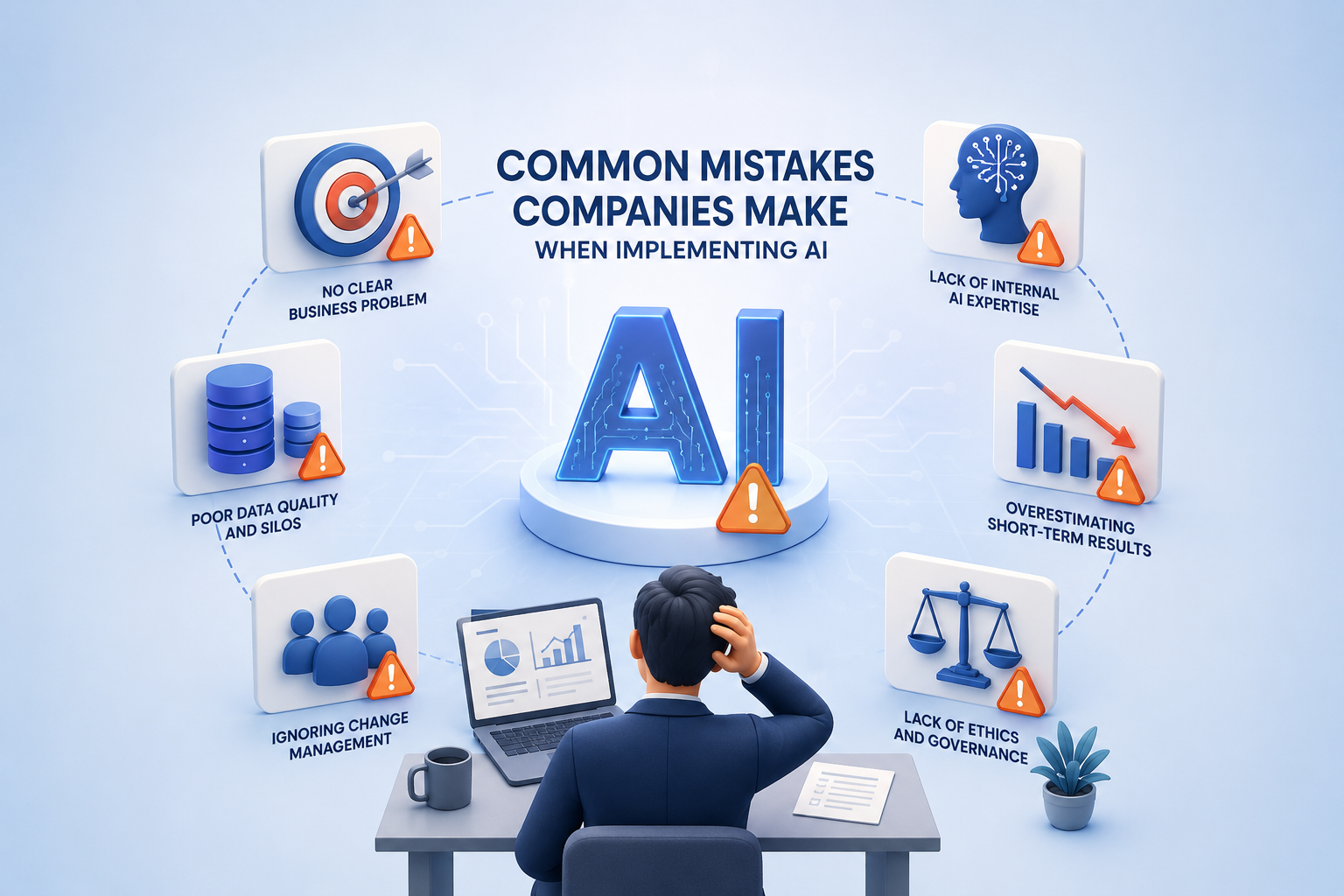
Common Mistakes Companies Make When Implementing AI
TL;DR — AI doesn't fail because the models are weak. It fails because companies skip strategy, ignore data quality, and underestimate people. Below are the most common traps — and how to step around them.
Artificial Intelligence has shifted from a buzzword to a real competitive lever. Yet according to multiple industry reports, 70–80% of enterprise AI projects never make it to production. The reasons are surprisingly consistent — and almost always organizational, not technological.
Let's break down the most common mistakes.
🎯 1. Starting with Technology Instead of Business Problems
One of the biggest mistakes is buying AI tools before defining the actual problem. Companies often say "we need AI" instead of asking "what business issue are we trying to solve?"
What goes wrong:
- Teams chase trendy models (LLMs, agents, RAG) without a use case
- Budgets get burned on POCs that solve nothing measurable
- Leadership loses trust in AI initiatives after the first failure
✅ How to avoid it:
Start with a business KPI, not a model.
Reduce churn by 5%. Cut support resolution time by 30%. Automate 60% of invoice processing. Then pick the tool.
🗄️ 2. Poor Data Quality and Data Silos
AI systems are only as good as the data they're trained on. Most companies dramatically underestimate how messy their data really is.
Common issues:
- 🔸 Incomplete or inconsistent datasets
- 🔸 Outdated records nobody owns
- 🔸 Data trapped in isolated systems (CRM, ERP, spreadsheets)
- 🔸 No clear data lineage or schema documentation
- 🔸 Missing labels for supervised learning
Without unified, governed data pipelines, even GPT-class models will produce unreliable, biased, or hallucinated results.
✅ How to avoid it:
Invest in data infrastructure before models. A boring data warehouse beats a fancy model every time.
👩💻 3. Lack of Internal AI Expertise
Companies often assume that buying an AI tool is enough. In reality, successful implementation requires teams who understand:
- Machine learning — model selection, training, evaluation
- Data engineering — pipelines, quality, observability
- MLOps — deployment, monitoring, retraining
- Domain knowledge — without it, models optimize the wrong thing
Without internal expertise, businesses become fully dependent on vendors and can't adapt when needs change.
✅ How to avoid it:
Build a small, cross-functional AI team early — even 2–3 people with the right mix beats a 20-person consultancy with no domain context.
🧭 4. Ignoring Change Management
AI implementation is not just a technical shift — it's an organizational one. Employees may resist AI tools due to:
- Fear of job loss
- Lack of training
- Distrust of "black box" decisions
- Unclear ownership ("Is this still my job?")
Companies that skip training and communication often see low adoption rates — the tool works, but nobody uses it.
✅ How to avoid it:
Treat AI rollout like a product launch internally. Document, train, demo, gather feedback, iterate.
⏱️ 5. Overestimating Short-Term Results
AI is not a magic switch. Many leaders expect ROI in weeks and lose patience when results take months.
In reality, AI systems require:
- Data preparation (often the longest phase)
- Model training and evaluation
- Integration with existing systems
- Continuous monitoring and retraining
- Gradual rollout with feedback loops
✅ How to avoid it:
Set realistic horizons: 3–6 months for a meaningful pilot, 12+ months for production impact. Communicate this upfront.
⚖️ 6. Lack of Ethics and Governance
As AI becomes more powerful, ethical risks multiply. Bias in models, opaque decision-making, and improper data use can lead to reputational damage, lawsuits, and regulatory fines (especially under the EU AI Act).
Watch out for:
- 🔻 Biased training data leading to unfair outcomes
- 🔻 No explainability for high-stakes decisions
- 🔻 Personal data used without consent
- 🔻 No human-in-the-loop for critical workflows
✅ How to avoid it:
Establish an AI governance framework before deployment — not after an incident. Companies like OpenAI and Google DeepMind publish responsible AI guidelines worth borrowing from.
🔁 7. Treating AI as a One-Time Project
A model deployed today will drift tomorrow. User behavior changes, data distributions shift, and accuracy quietly degrades — a phenomenon called model drift.
Companies that treat AI like a software release ("ship it and move on") wake up months later wondering why predictions got worse.
✅ How to avoid it:
- Monitor model performance in production
- Set up automated retraining pipelines
- Track input data drift, not just accuracy
- Schedule regular model audits
🔐 8. Underestimating Security and Privacy Risks
AI introduces new attack surfaces that traditional security playbooks don't cover:
- Prompt injection in LLM-powered apps
- Data leakage through model outputs
- Model poisoning via compromised training data
- Sensitive data sent to third-party APIs
✅ How to avoid it:
Treat your AI systems like any other production service: threat-model them, audit dependencies, and never send raw PII to external models without redaction.
📋 Quick Checklist Before Launching an AI Project
- [ ] Is there a clearly defined business problem and measurable KPI?
- [ ] Do we have clean, accessible data for this use case?
- [ ] Do we have (or can we build) the right team?
- [ ] Is there a change management plan for end users?
- [ ] Have we set realistic timelines with stakeholders?
- [ ] Do we have a governance and ethics framework?
- [ ] Is there a plan for monitoring and retraining after launch?
- [ ] Have we assessed security and privacy risks?
🚀 Conclusion
AI can deliver enormous value — but only when implementation is grounded in strategy, data, people, and governance. The technology is the easy part; the organization around it is where most projects succeed or fail.
Companies that avoid these eight mistakes don't just adopt AI — they turn it into a lasting competitive advantage.
The winners in the next decade won't be the ones with the biggest models. They'll be the ones with the clearest problems, cleanest data, and best-prepared teams.